One of the greatest misconceptions about education is that its purpose is to produce the right answers.
Schools reward correct responses. Examinations measure accuracy. University admissions often depend upon demonstrating mastery of existing knowledge. After years of education, it is easy to conclude that success belongs to those who make the fewest mistakes.
But life rarely works that way. Outside the classroom, the people who make the greatest contributions are not distinguished by always being right. They are distinguished by recognising when they are wrong and having the confidence to change their minds. Scientific discovery depends upon disproving accepted ideas. Entrepreneurs survive by abandoning strategies that no longer work. Investors revise their assumptions as markets evolve, while doctors continually adapt their practice as new evidence emerges. Progress has always depended less upon certainty than upon the willingness to reconsider it.
That quality is becoming even more valuable. Artificial intelligence can retrieve facts within seconds and summarise almost any subject with remarkable speed. The ability to repeat information is no longer the advantage it once was. Judgement has become far more important, and good judgement begins with intellectual humility. People who believe they already know everything rarely discover anything new.
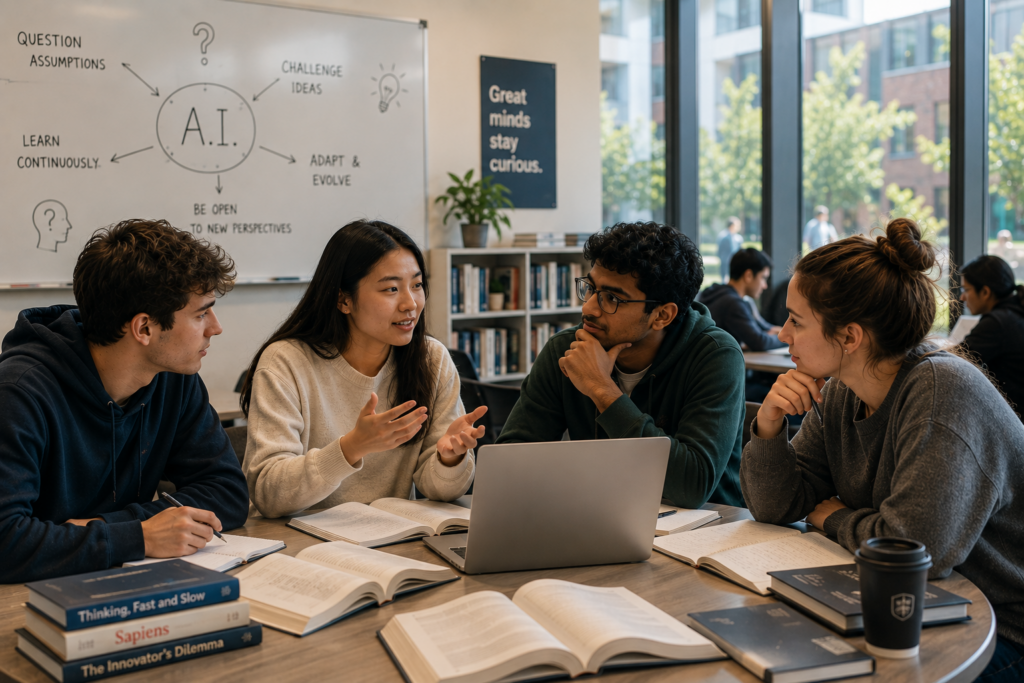
The most memorable teachers I encountered were not those who simply delivered information. They encouraged questions that had no obvious answer. They challenged assumptions, welcomed disagreement and demonstrated that changing one’s mind was not a sign of weakness but a mark of intellectual maturity. They understood that education should cultivate curiosity before confidence and critical thinking before certainty.
This lesson extends well beyond academic life. Every meaningful career involves moments when long-held beliefs are tested by new experiences. Markets change. Technologies evolve. Society moves in unexpected directions. The people who continue growing are rarely those who defend every previous decision. They are the ones who remain curious enough to ask whether there is a better way forward. Confidence has its place, but confidence without reflection easily becomes complacency.
The same principle applies to leadership. Leaders are often expected to project certainty, yet history offers countless examples of organisations that struggled because nobody was willing to challenge prevailing assumptions. Strong leadership is not defined by having every answer. It is defined by creating an environment where evidence matters more than ego, where thoughtful disagreement is welcomed and where changing direction in the light of better information is regarded as wisdom rather than inconsistency.
This belief has influenced the William S.D. Louey Educational Foundation from the very beginning. Academic achievement has always been important, but grades alone reveal only part of a student’s potential. Equally important is the willingness to remain open-minded, to question accepted ideas and to continue learning long after formal education has ended. Those qualities cannot always be measured in examinations, yet they often determine how individuals respond to opportunities and challenges throughout their lives.
Looking back, very few people remember the examination questions they answered correctly. We remember the conversations that challenged our thinking, the books that changed our perspective and the moments when we realised our assumptions had been incomplete. Those experiences shape judgement far more deeply than memorised facts because they teach us that learning is not the process of defending what we already know. It is the process of expanding what we are prepared to understand.
Education should certainly help students build knowledge, but knowledge is only the beginning. The greater purpose is to develop minds that remain curious, adaptable and willing to change when new evidence demands it. The best students are not those who never make mistakes. They are those who never stop learning from them.