There is a certain comfort in knowing that something works. Whether it is a method of studying, an approach to solving problems, or an argument we have successfully made before, we naturally gravitate towards what is familiar. After all, if something has brought us success in the past, why should we not use it again?
But I believe this is one of the more interesting challenges in education. The very knowledge that helps us succeed can sometimes prevent us from learning something new.
Consider a university student who has spent weeks researching a subject and produced an excellent essay. A year later, a similar assignment comes along. The student already understands the topic, has developed convincing arguments, and knows how to structure the work. It would be easy to return to the earlier essay, make a few adjustments, and submit something that appears new.
The work may still be well written. The arguments may still be valid. But has the student actually learned anything more?
This is a question worth asking because education should not simply reward our ability to produce good work. It should encourage us to develop new perspectives, reconsider our assumptions, and become more capable thinkers.
A recent study offers an interesting perspective on this issue. Published in the International Journal for Educational Integrity in 2026, a study examining two decades of student plagiarism surveys at Western Sydney University found that students’ understanding of academic integrity had improved significantly over time. Yet one practice, described as “recycling”, remained among the least well-understood forms of plagiarism.
In this context, recycling refers to students reusing previously submitted work without appropriate acknowledgement or permission. Interestingly, the researchers found that although students had become more aware of academic integrity overall, uncertainty around reusing one’s own work persisted. The study also suggested that the way assignments are designed can influence whether students fall back on previous submissions.
This finding raises a larger question about how we approach education. We are generally taught to respect other people’s ideas and acknowledge their contributions. But how often do we consider our responsibility to develop our own thinking rather than simply repeat it?
There is nothing wrong with returning to something we have previously learned. In fact, much of education is built upon earlier knowledge. A student cannot study advanced mathematics without understanding basic principles, just as a researcher cannot make meaningful discoveries without examining existing research.
The difference lies in what we do with that foundation. If we return to an earlier idea to question it, strengthen it, or explore it from another perspective, we are continuing the learning process. But if we simply reproduce the same work because it is convenient, we may be missing the very opportunity that education is meant to provide.
Of course, students today face considerable pressure. Academic expectations are high, deadlines can be demanding, and there is often an understandable desire to achieve the best possible results. Under these circumstances, efficiency can easily become a priority.
Technology has made this tension even more relevant. According to the Higher Education Policy Institute’s Student Generative AI Survey 2026, 94% of surveyed UK undergraduates reported using generative artificial intelligence to help with assessed work. Almost half believed AI had improved their student experience, particularly by saving time and helping them understand difficult concepts.
These findings illustrate how rapidly the learning environment is changing. Students now have access to tools that can summarise information, organise arguments, and help them complete tasks far more quickly than before.
I do not believe that efficiency is necessarily a bad thing. New technologies can create valuable opportunities, particularly when they make knowledge more accessible. But we should be careful not to confuse completing a task more efficiently with understanding it more deeply.
The same applies when we rely too heavily on our previous work. An assignment completed with minimal effort may satisfy an immediate requirement, but it may not develop the judgment, creativity, or intellectual independence that will be valuable in the future.
To me, the real question is not simply whether we can produce an answer. It is whether we can explain that answer, defend our reasoning, and recognise when our understanding needs to change.
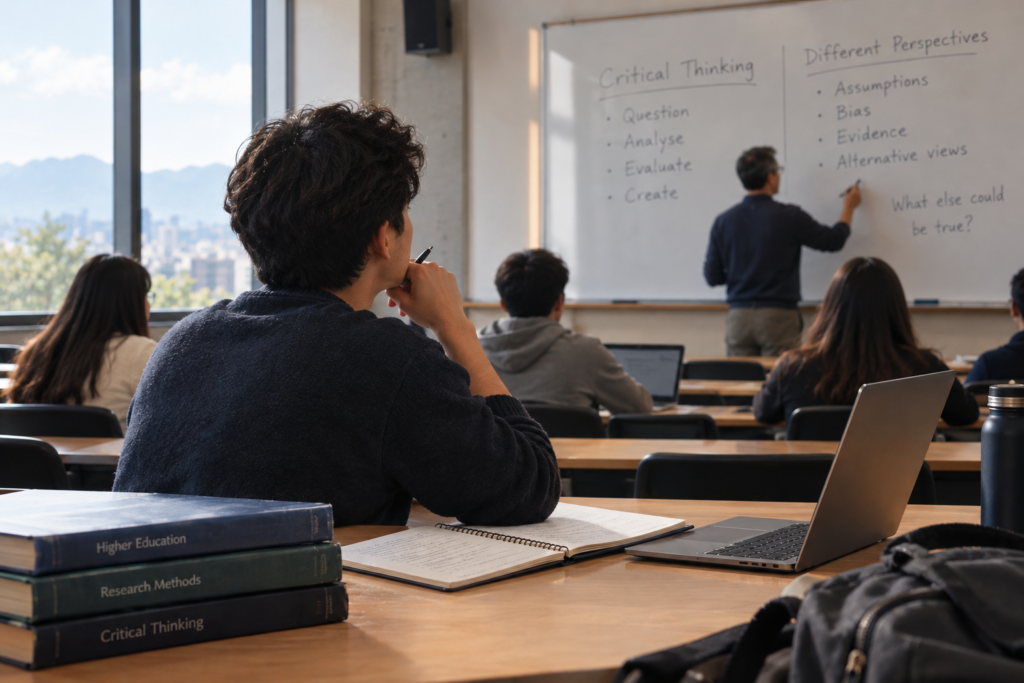
A curious student does not stop at finding a satisfactory answer. They ask whether another explanation might exist. They consider why someone else may reach a different conclusion. They look for information that challenges their understanding rather than only seeking evidence that confirms it.
These habits are not always easy to develop. It can be uncomfortable to discover that an argument we once believed was convincing is incomplete, or that a method we have relied upon is no longer the most effective.
I have always felt that one of the most valuable things education can teach us is the ability to change our minds for the right reasons. Being knowledgeable does not mean being certain about everything. It means having enough understanding to recognise what we know, what we do not know, and what we still need to discover.
This also requires a degree of intellectual honesty. When we build upon our earlier work, we should recognise what has already been accomplished and be transparent about what we are contributing now. In academic settings, that means understanding the expectations surrounding previously submitted work and seeking permission or providing acknowledgement where necessary.
These principles are important not simply because institutions have rules, but because trust is fundamental to education. A qualification should represent genuine learning, just as a piece of research should represent an honest contribution to knowledge.
However, responsibility should not rest entirely with students. The 2026 academic integrity study also draws attention to the role of educators in designing assessments that encourage original engagement rather than repeated answers. If students are continually asked to respond to the same questions in the same way, it is perhaps unsurprising that some will return to familiar material.
I believe this is an important consideration. Good education should challenge students to apply what they know in unfamiliar situations, connect ideas across different subjects, and explain how their thinking has developed.
Rather than asking students only to demonstrate what they have remembered, we should also encourage them to show what they have reconsidered.
Through the William S.D. Louey Educational Foundation, I hope to encourage young people to approach their education with this sense of curiosity and responsibility. Academic achievement is important, but it should not become the only measure of success.
A student who receives an excellent grade has achieved something worth recognising. Yet a student who learns to question an assumption, develops a new way of approaching a problem, or gains the confidence to explore an unfamiliar idea has also made meaningful progress.
These qualities become increasingly valuable beyond the classroom. In business and leadership, experience is often considered one of our greatest assets. We learn from previous decisions, recognise patterns, and develop an understanding of what works. But experience can also become a limitation if we assume that yesterday’s solutions will always be appropriate for tomorrow’s challenges.
A successful leader must know when to draw upon past experience and when to challenge it. The same applies to anyone who hopes to contribute meaningfully to their profession or community.
We should take pride in what we have achieved, but we should never become so attached to our previous successes that we stop looking for better ways forward.
Perhaps this is the deeper lesson behind the research on academic integrity. The issue is not simply whether students understand the rules surrounding their work. It is whether our education system consistently encourages them to see each new assignment, project, and challenge as an opportunity to grow.
After all, the purpose of education is not to keep proving that we know something. It is to expand what we are capable of understanding.
What we learned yesterday should give us the confidence to ask better questions today, not become an excuse to stop asking them.
And if we can carry that mindset beyond our years in education, we will have gained something far more valuable than any individual grade or qualification: the willingness to keep learning, even when we think we already know the answer.