For decades, when families in Asia thought about international education, their attention often turned to universities in the United States, the United Kingdom, Australia or Canada. Studying overseas was seen as a way to gain a world-class education, experience a different culture and open doors to a global career.
That picture is changing. A recent report by The PIE News highlights the remarkable growth of Hong Kong’s higher education sector, driven largely by increasing numbers of students from mainland China. In the 2024/25 academic year, Hong Kong recorded 172,614 higher education enrolments, an increase of 12% from the previous year. Non-local enrolments grew even faster, rising 24% to 88,949.
According to the report, non-local students now account for 52% of enrolments within the higher education population covered by the research, compared with 41% five years earlier.
These numbers tell an important story. Hong Kong is becoming an increasingly attractive destination for students seeking a high-quality education with international connections.
But I believe the significance goes well beyond Hong Kong.
It tells us something about how the global education landscape is evolving, what students and families value, and how cities can position education as a driver of their future.
The Geography of Opportunity Is Changing
One of the most interesting aspects of this trend is that students no longer necessarily have to travel halfway around the world to access an internationally connected education.
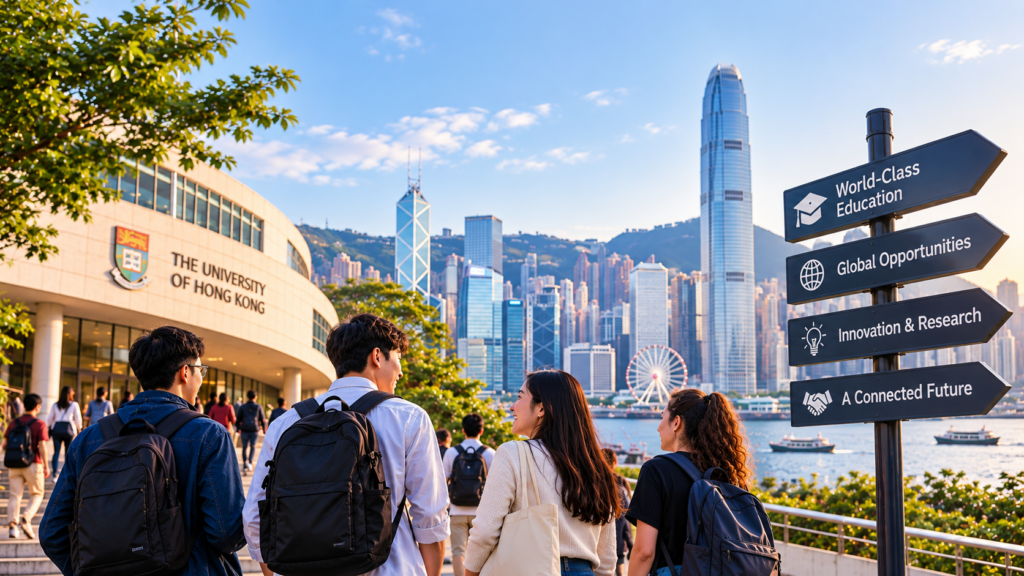
Hong Kong occupies a distinctive position. It offers internationally recognised universities, an environment shaped by both Chinese and international influences, and close connections to one of the world’s largest economies.
For mainland Chinese students, these advantages can make Hong Kong an attractive choice. It offers geographical proximity and cultural familiarity while providing opportunities to develop a broader international outlook.
This is an important reminder that international education is not defined simply by distance from home. Its real value lies in exposure to new ideas, different perspectives, strong academic standards and opportunities that students might not otherwise encounter.
For universities around the world, Hong Kong’s experience suggests that the traditional map of international student mobility is becoming more complex. Students are evaluating a wider range of destinations, and regional education hubs are increasingly part of that decision.
Education Is Becoming Part of a Bigger Economic Strategy
Another important lesson is how closely Hong Kong’s education ambitions are linked to its wider economic development.
The government has been expanding opportunities for non-local students, with the enrolment ceiling at publicly funded post-secondary institutions rising to 50% of local student places from the 2026/27 academic year.
There are also plans for university towns in the Northern Metropolis, bringing higher education, research, technology and industry into closer proximity.
I find this particularly significant.
Universities should never be viewed simply as places where students attend lectures and earn qualifications. At their best, they are centres of research, creativity, entrepreneurship and exchange. They attract talent, generate ideas and help create the next generation of businesses and industries.
When education is connected thoughtfully to the wider economy, its benefits can extend far beyond the campus.
This is a lesson for cities everywhere. Investing in universities is an investment in more than students. It is an investment in the intellectual and economic capacity of society.
Growth Is Not the Same as Globalisation
There is, however, an important distinction between attracting more non-local students and building a genuinely international education environment.
The latest figures show that mainland Chinese students account for 79% of non-local enrolments in programmes funded by Hong Kong’s University Grants Committee.
That reflects the strength of Hong Kong’s relationship with the mainland and the confidence many families place in its universities.
But it also raises a question: how can Hong Kong build on that success while attracting students from a wider range of countries and backgrounds?
The government is already looking towards Southeast Asia, the Middle East and other international markets.
I believe this next stage matters enormously.
A truly international university is not defined only by how many students arrive from outside its borders. It is defined by the diversity of experiences and ideas those students bring, and by how effectively they learn from one another.
Students benefit when they share classrooms, friendships and projects with people who see the world differently.
That kind of exchange develops curiosity, empathy and the ability to work across cultures. These qualities are increasingly important in a world where many of our greatest challenges require international cooperation.
Hong Kong has an opportunity to become a larger education hub and a more globally connected one.
The Student Experience Must Keep Pace
Rapid growth also brings responsibilities.As more students arrive, universities and policymakers must consider whether accommodation, campus facilities, academic support and career opportunities can keep pace.
These are not secondary concerns. They are central to the quality of education.
A student’s university experience is shaped by far more than the classroom. It includes whether they feel welcome, whether they can form meaningful relationships, whether they have access to guidance and whether their education helps them build a future.
For international students especially, arriving in a new environment can be exciting but also challenging.
If Hong Kong wants to strengthen its reputation as an education destination, it must continue to invest in recruitment and university capacity, and in the experience students have once they arrive.
Ultimately, a university’s reputation is carried into the world by its graduates. Their experiences, achievements and connections become part of its legacy.
What Hong Kong’s Rise Shows the World
To me, Hong Kong’s education boom points to three broader changes.
First, the future of international education will be more geographically diverse. Established destinations will remain important, but students will increasingly consider high-quality opportunities closer to home and in emerging regional hubs.
Second, education will play an increasingly strategic role in economic development. Cities that connect universities with research, innovation and industry will be better placed to attract and develop talent.
Third, the true measure of an education hub will not be enrolment growth alone. It will be the opportunities created for students, the diversity of its academic community and the contribution its graduates make to society.
Hong Kong has made impressive progress in attracting students. The next challenge is to translate that momentum into lasting educational value.
I have always believed that education has the power to change the direction of a person’s life. It gives young people confidence, broadens their horizons and helps them discover possibilities they may never have imagined.
Hong Kong’s rise as an education destination is not simply a story about where students choose to study. It is a story about how opportunity is shifting around the world.
And it is a reminder that the most successful education systems will be those that do more than attract talent. They will help that talent grow, connect and contribute to a better future.