More than two thousand years ago, the mother of the Chinese philosopher Mencius noticed that her son was learning things nobody had taught him.
Their home was near a cemetery, and Mencius began copying the funeral rituals he saw around him. His mother moved them near a marketplace, only to see him begin imitating the merchants. So she moved again, this time near a school.
There, Mencius watched students studying and practising the customs expected of scholars. His mother decided they had finally found the right place to live.
The story became known in China as 孟母三迁, or “Mencius’ mother moves three times.” It is usually told as an example of a mother’s determination to give her child a good education. What interests me more is the behaviour of Mencius himself. Nobody had instructed him to perform funeral rituals or imitate merchants. He simply copied what he saw.
And children still do this remarkably well. We tend to think about education in terms of what is deliberately taught. We compare schools, examination results, universities, qualifications and teaching methods. But a considerable amount of learning happens without anyone deciding that a lesson is taking place. Children notice what adults admire, what they complain about and how they behave when things go wrong. They quickly work out what receives attention and what does not.
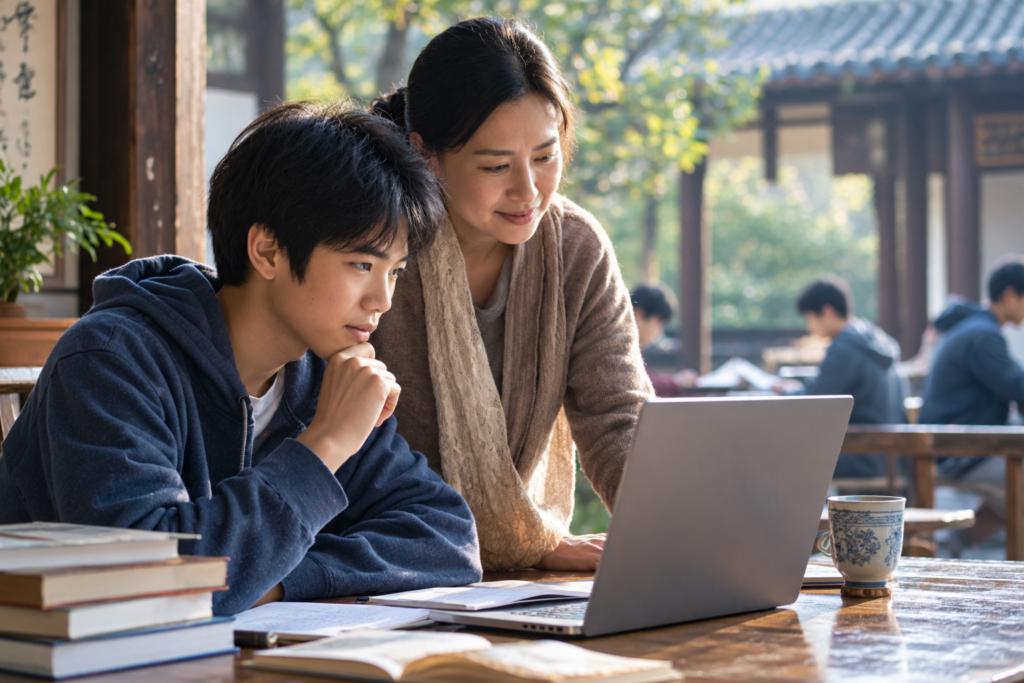
The modern version of the Mencius story has an additional complication. His mother could see the influences she wanted to change. Today, many of those influences arrive through a screen.
Moving house three times would no longer solve the problem. A young person can encounter ideas, interests and people from almost anywhere in the world without leaving home. This has opened possibilities for learning that previous generations could not have imagined, but it has also made the ability to judge what we encounter far more important.
Access to information is not the same as education. Finding an answer is easy; deciding whether it is a good answer is harder. Young people need to know what deserves their attention, what deserves their trust and when something that sounds convincing should still be questioned.
As students grow older, this distinction becomes even more important. By the time they reach university, the aim should no longer be simply to place good influences around them. They need to develop the judgement to navigate competing ideas for themselves.
This also changes the value of higher education. Universities were once among the few places where a student could gain access to specialist knowledge, large libraries and people who had spent their lives studying a subject. Today, much of the information itself can be reached from almost anywhere. What is harder to reproduce is the experience of having an argument challenged by someone who knows the subject better, discussing an idea with classmates who see it differently, or discovering that a confident opinion does not survive closer examination.
A university education should therefore do more than transfer knowledge from one generation to the next. It should give students practice in deciding what to do with knowledge. That means learning how to ask better questions, test an argument, distinguish evidence from assertion and change a view when the evidence changes. These habits are useful in academic life, but they become even more useful once students enter professions where the problems rarely arrive with one correct answer at the back of the book.
In this sense, the role of a good professor is not so different from the role suggested by the old Mencius story. The objective is not to tell students what to think. It is to expose them to serious ideas, challenge them when their reasoning is weak and gradually make the teacher less necessary. Education starts with guidance, but it should lead towards independence.
Adults also teach through what they demonstrate. Young people are quick to notice the difference between what we recommend and what we actually value. What we repeatedly do can be more persuasive than what we occasionally tell them to do.
This is why I think the story of Mencius’ mother has lasted for so long. She understood that education was not simply a matter of giving her son more to learn. She was thinking about what would shape the way he saw the world.
That distinction feels even more important today. Young people no longer suffer from a shortage of information. They have more knowledge, opinions and answers within reach than any generation before them. The task changes as they grow: first helping them encounter what is worth knowing, and then giving them the judgement to decide for themselves.
Mencius’ mother could pack up their belongings and move to a better neighbourhood. Today, the marketplace, the classroom, the university and a thousand other voices can all arrive on the same screen.
We cannot keep moving the house. Education has to prepare the person who eventually walks out of it.