
Research report · November 2026
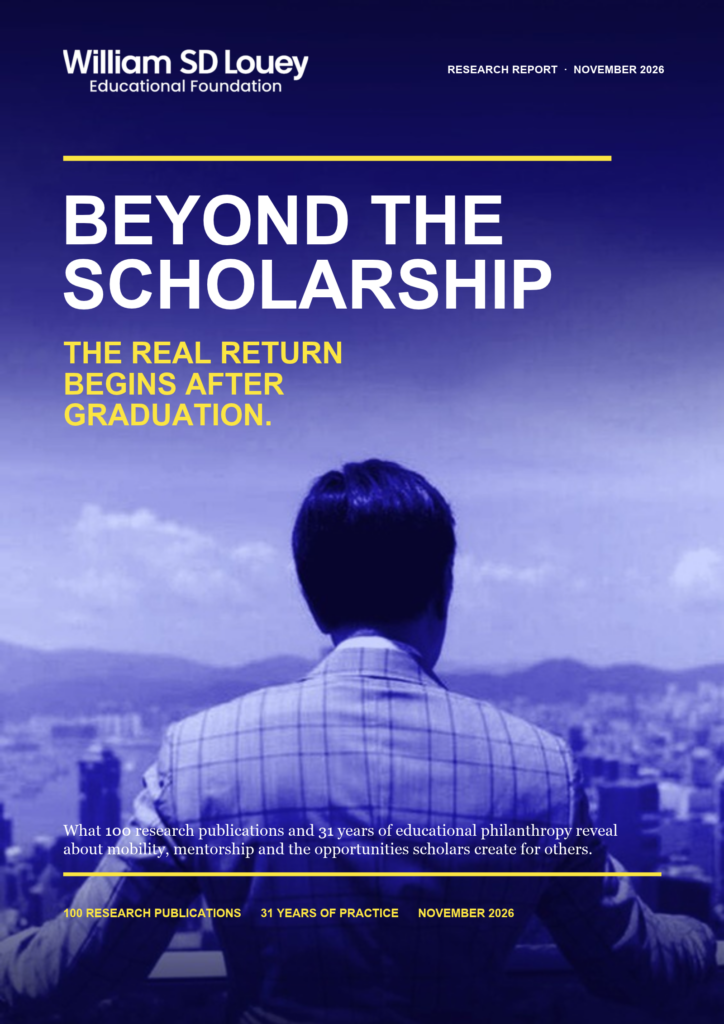
Beyond the scholarship.
The real return begins after graduation. What 100 research publications and 31 years of educational philanthropy reveal about mobility, mentorship and the opportunities scholars create for others.
 Read the full report →
Why this report
How should a scholarship be measured?
Scholarships are usually judged at graduation: grades, degrees and first jobs. Yet the most important returns may only become visible years later, in the careers scholars build, the families they support and the opportunities they go on to create for others. Of the causal studies reviewed for this report, only 13% followed outcomes for ten years or more.
Beyond the Scholarship combines a critical synthesis of 100 research publications, from randomised trials to meta-analyses, with 31 years of the William S.D. Louey Educational Foundation’s practice and a 2026 survey of its alumni. It builds on the Foundation’s earlier work on the long-term impact of scholarships.
Key findings · 2026 alumni survey
What the scholars told us.
have mentored or guided others, with at least 22.7 mentoring relationships each on average
say their award paid for schooling that would otherwise have been unaffordable
have held leadership responsibilities
have given to educational or charitable causes
describe themselves as entrepreneurs or business owners
began Foundation support at secondary school
Percentages of 12 participating alumni from approximately 35 scholars supported since 1995. Responses are self-reported and describe association, not cause. Full methods and denominators are in the report’s annexes.
Modelled, not observed
The William Louey Effect.
percentile points above a modelled Chinese mobility benchmark, from the report’s income-rank analysis of participating scholars.
additional upward mobility that sustained personal guidance could add compared with a conventional, funding-only scholarship.
Both figures are scenario estimates rather than observed comparisons. The report sets out its assumptions, survey base and sensitivity analysis in full, and invites researchers to test them.
Financial aid opens access. Relationships extend impact.
The central conclusion of Beyond the Scholarship
Reading it critically
What the evidence can’t tell us.
The report is candid about its limits, and asks to be examined critically.
- 12alumni responded, from about 35 scholars. The sample is small and self-selected.
- 50%of respondents think they might have followed a similar path without the scholarship.
- 13%of causal studies reviewed followed outcomes for ten years or more, which is why long-term evidence is so scarce.
- 83%of respondents had at least one degree-educated parent. Scholars were not typically first-generation students.
Read the full report
The scholarship is the first link, not the last.
90 pages of evidence, scholar stories and methods, with a foreword by William Louey.